Most investors start their search with listings. They scroll, book inspections and try to decide which property feels right. The investors who build strong portfolios start somewhere else: a written set of criteria that every property must pass before it earns their time.
That document is a property buy-box. For Australian investors, a well-built buy-box links your strategy to the search, sets clear financial limits and turns every listing into a quick yes-or-no decision. This guide walks through how to build one in six steps, what a finished buy-box looks like and how to keep it current as your portfolio grows.

A property buy-box is the bridge between your plan and the market. Your strategy defines where the portfolio is heading. The buy-box translates that direction into specific rules for price, location, asset type, yield, holding cost and risk.
With those rules written down, three things change. You filter listings in minutes. You approach each inspection with clear questions. And when an agent creates urgency, you have a fixed standard to measure the property against. Our guide on how to choose an investment property in Australia explains why the buy-box comes first. This guide focuses on building one.
Work through these steps in order. Each one narrows the field and sharpens the criteria that follow.
Every property in a portfolio has a job. It might drive long-term capital growth, lift income, diversify your holdings or set up the next purchase. Decide that role first, because it shapes every criterion that follows. A growth-focused purchase points toward land content and scarcity. An income-focused purchase puts more weight on yield and tenant demand. Defining the role is one of the core tasks of a property advisor, and it gives the buy-box its purpose. Write the role as a single sentence, such as "a house in a growth market that builds equity for the next purchase within five years."
Price is one part of the financial picture. Your buy-box should also set limits for:
Moneysmart recommends comparing expected rent with every ongoing cost and planning for periods without a tenant. Build those assumptions into your limits so the property still works if rates rise or rent softens. Setting limits this way protects The Sequence across every purchase in the plan.
Location criteria describe the kind of market you want, which keeps your options open across several suburbs and regions. Set measurable thresholds for:
Our guide on how to spot an investment-ready suburb explains how to read each of these signals. Choose thresholds you can check with public data, so every suburb is measured the same way.
Define the property itself: house, townhouse or apartment, minimum land size, age and condition, number of bedrooms and any strata limits. Include the features tenants in that market expect, such as off-street parking or a second bathroom.
The 2026 tax reforms add a new decision to this step. From 1 July 2027, negative gearing on residential property bought after 12 May 2026 is limited to qualifying new builds, according to Treasury. Decide whether your buy-box targets new or established stock, and model the cash flow for each option.
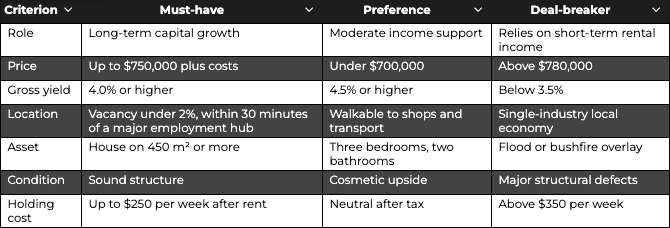
A buy-box works best in three tiers. Must-haves are the criteria every property has to meet, such as price, yield and vacancy thresholds. Preferences add value and help you rank the properties that pass, such as a north-facing yard or walkable cafes. Deal-breakers end the assessment immediately, such as a flood overlay, major structural defects or a single-industry local economy.
This structure keeps you flexible where it helps and firm where it counts. A property that meets every must-have but misses two preferences stays on the list, while one that trips a single deal-breaker leaves it.
A buy-box held in your head shifts with every open home. Put it on one page and share it with your broker, accountant, conveyancer and property manager. Each can test it from their angle: finance, tax, legal risk and rental demand. The result is a single document the whole team works from. Date the document, too, so you can see how your criteria evolve across the portfolio.
The table below shows how a completed buy-box might look for a growth-focused investor. The figures are illustrative only. Your own criteria should come from your numbers, your strategy and current market data.

Once the buy-box is set, the search becomes a filter. Screen each listing against the must-haves and deal-breakers first. Most properties fall away at this stage, which saves hours of inspections. Score the ones that pass against your preferences, then take the strongest two or three into full assessment using the 2026 due diligence checklist.
The buy-box also sharpens your read on value. When a property passes every must-have, you can move quickly and negotiate with confidence. When one falls short, you can walk away early and keep your capital for the right purchase. For a deeper look at testing a shortlisted property, see our guide to assessing a property deal beyond yield.
The same discipline helps at auction or in a competitive private sale. With your price ceiling and must-haves agreed in advance, you can bid or make an offer knowing exactly where your limit sits.

Review your buy-box at set points:
Make changes deliberately and between searches. Adjusting criteria mid-campaign to fit a property you like undoes the discipline the buy-box was built to create.
A property buy-box should include the property's role, your financial limits, a location profile, an asset specification and a clear split between must-haves, preferences and deal-breakers.
Firm on must-haves and deal-breakers, flexible on preferences. That balance protects the plan while leaving room to act on a strong opportunity.
Yes. Each purchase changes your borrowing capacity and portfolio mix, so the next buy-box should reflect the role the next property needs to play.
A property buy-box gives Australian investors a clear standard before the market applies pressure. It links each purchase to your strategy, keeps your finances protected and turns a long search into a series of fast, confident decisions. Build it before you open a listing, share it with your team and review it after every purchase.

TWO WAYS IN

A 90-minute session with a senior advisor. A written diagnostic within 48 hours. You'll walk away knowing exactly where you stand today, where you're heading, and the moves required to bridge the gap.
Book The Clarity Brief™$990 · 90 minutes · diagnostic in 48hrs

A 5 minute diagnostic that reveals your archetype, your strengths and blind spots, and the wealth engine pattern most likely to work for you.
Discover your archetypeFree · 5 minutes · instant results
